Keeping a store freezer case in shape through a Connecticut summer
Most freezer-case problems start at the door, not at the compressor.
October 20, 2026 · 4 min read
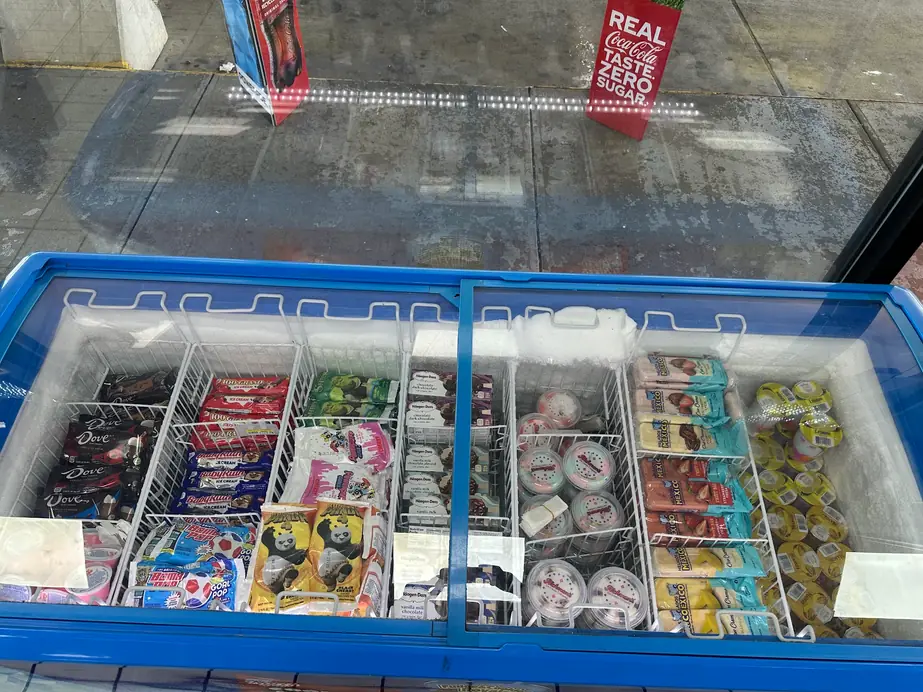
Summer is when a store freezer works hardest. The door opens more often, the Saturday rush empties the front rows by noon, and a delivery sits on the loading dock a few minutes longer than it should. None of that takes special equipment. It takes a handful of habits, and almost all of them are free. What follows is general freezer craft for a convenience store, deli, or market. It isn't a health code guide, so check your own local requirements for anything regulated, including what temperature your case should hold.
Rotate so the oldest stock sells first
New stock goes behind or under what's already there. In an upright case, pull the old product forward and load the new boxes behind it. In a chest freezer, dig: lift the top layer out, put the new stock on the bottom, and set the older stock back on top. It adds a few minutes to every restock. It also keeps a forgotten box from sitting under three newer ones until the frost has its way with it.
Write the delivery date on the carton with a marker. Memory doesn't hold up through a long July weekend, and a date on the box lets any employee rotate correctly without asking you. Check the manufacturer's code on a package any time something looks off: frost crystals inside the wrapper, a bar that went soft and refroze into a different shape, or a lid that bulged.
Treat every door opening as a cost
Each time the door swings open, warm and humid air rushes in, and the moisture in that air ends up as frost on the walls and on the product. A customer who stands there with the door wide open, choosing between a fruit bar and a cone, costs you a little each time. Multiply that by a summer of customers and it shows up as thick frost and a compressor that never gets to rest.
Fix it with layout, not signs. Put the best sellers at eye level and at the front so a customer grabs and closes. Keep glass clean so people can choose with their eyes. On a solid-lid chest, tape a simple map of what's where to the lid. And load in batches: bring the whole restock to the case in one trip, on a cart or in a cooler, instead of making five trips with the door open.
Give the cold air room to move
A freezer holds product cold by moving air around it. Boxes stacked against the back wall, jammed over a vent, or piled above the load line block that flow. The result is a case that runs warm in one corner and frosts over in another while the dial says everything is fine. Check your equipment's manual for the fill line and the clearances it wants, and respect them even when a big delivery tempts you to squeeze in one more row.
Keep a thermometer inside the case and read it at opening and closing. The number you want is the one your equipment maker and your local health department give you, not one from a blog post. What matters on your side is the trend. If the reading creeps up three days in a row, call for service before the product tells you.
Defrost on a slow day, with a plan
Frost is insulation in the wrong place. Once it builds up enough to narrow the shelves or catch the lid, schedule a defrost for a slow weekday. Move the product into coolers packed with ice or into a second freezer, follow the manufacturer's defrost steps, let the frost loosen, and wipe the inside dry before you restart.
Never chip frost with a knife or a screwdriver. One slip can puncture a line, and then you don't have a frosty freezer, you have a dead one. A plastic scraper and patience do the job. Put the product back in the order you want it sold, oldest on top, and wipe the gaskets while you're there so the door seals tight.
Put each kind of product where it sells
- Novelty bars: upright at the front and at eye level, since they're grab-and-go.
- Pints: at hand height behind glass, labels facing out so a customer can find a flavor without digging.
- Cups and kids' items: where a child can see them from the aisle.
- Slow movers and bulk tubs: low or toward the back, away from the first reach.
Review the layout once a month in summer. What sold out moves forward, and what hasn't moved in three weeks goes back or gets a better spot. The case should look like what your customers actually buy, not what you ordered in May.
When the case runs low between drops
No layout fixes an empty case. Joe's Ice Cream, a wholesale distributor at 26 Clifton Street in West Haven, delivers weekly or bi-weekly with no minimum on any purchase, in sizes from single ice creams to three-gallon tubs. Evening delivery runs Monday to Friday 5:30 PM to 8:00 PM, Saturday 12:00 PM to 10:00 PM, and Sunday 12:00 PM to 7:00 PM. Warehouse pickup is 4:00 AM to 11:00 AM, and their site encourages pickup to save money.
Walk the case before you call and count what's gone and what's about to be. They ask for your address, the number of products, and a maximum or minimum spend, and the product amount and distance have to be settled before a truck leaves. Call the warehouse line at (203) 934-5576. William Gambardella answers from 5:00 AM to 11:00 AM.
Joe's Ice Cream, (203) 934-5576
Call (203) 934-5576More articles
How a West Haven store restocks ice cream without a minimum order
No minimum does not mean a mystery stop. The truck leaves when it knows the count and the distance.
What to ask before you book an ice cream truck for a Connecticut party
A lettered van is not a parlor. The quote is per item, and Jack is the after-hours line.